Wednesday, 10 July 2019

A Study of Adaptation - The Spy Who Loved Me

I'm wondering whether or not I should have skipped this one. The Spy Who Loved Me is Fleming's tenth entry in the book series, published in 1962. It's also the tenth entry in the film series, released in 1977. It's also an example of an adaptation which has virtually nothing to do with the source material other than a shared title.

The novel doesn't even follow Bond. Instead, we follow Vivienne Michel a Canadian receptionist at a motel in New York state, who narrates the story from a first-person perspective. In the first part, "Me", she talks about her past and two previous relationships which ended poorly. The second part, "Them", brings her into contact with two mobsters, "Sluggsy" Morant and Sol "Horror" Horowitz, who have come to burn down the motel so the owner can collect the insurance money. The third part, "Him", introduces her to Bond, who was passing through and realises that something is amiss.

In the film, Bond is on a mission to investigate the mysterious disappearance of a British nuclear submarine. Following a lead in Cairo, he meets Major Anya Amasova, a KGB agent who is investigating the similar disappearance of a Russian submarine. Their investigation soon leads them to Sardinia, and a shipping company owned by Karl Stromberg.

Other than the title, the only thing both versions share is the appearance of the villains. In the film, Stromburg's henchman, Sandor and Jaws, are partly based on Sluggsy and Horror. Both Sandor and Sluggsy are short, fat, and bald. Meanwhile, Horror is described as being tall and thin, with metal caps on his teeth. Jaws takes this up a few steps by having the metal teeth which give him his name.

The novel would not have transferred well to film. It's too sexually explicit (and cringe-inducing), and there's the fact that James Bond doesn't even appear until two thirds of the way in. In fact, Fleming himself disowned the story. He requested that it wasn't re-printed and wouldn't even grant the film rights for it. This is why we have the differences.

A letter Fleming wrote to his publisher revealed that he originally wrote The Spy Who Loved Me as an experimental cautionary tale, when he heard that his books were being read by younger audiences who were regarding Bond as a hero. He concluded by saying that the experiment went wrong. However, the first Bond film, Dr No, would be released six months after the book was published. Since there would have more of a demand for the protagonists to be heroic on screen compared to print, I guess Fleming's goals for this story would soon be moot.

Sunday, 7 July 2019

A Study of Adaptation - Thunderball

This post comes with a minor content warning, as there is a brief discussion of a possible sexual assault.

I think someone told Fleming that having Russian villains was old hat by this point. Thunderball is Fleming's ninth entry in the book series, published in 1961, and the fifth entry in the film series, released in 1965. Fleming initially co-wrote the story as a screenplay with Kevin McClory, which resulted in a legal battle. McClory would later produce a second adaptation, Never Say Never Again, released in 1983 but not part of the official film series (despite getting Sean Connery to reprise his role).

A criminal organisation known as SPECTRE (Special Executive for Counterintelligence, Terrorism, Revenge, and Extortion), spearheaded by Ernst Stavro Blofeld, has stolen two atomic bombs and are demanding a ransom from the NATO powers. Bond, who had been on leave at a health clinic after his last physical assessment, is sent to Nassau to investigate as part of Operation Thunderball. He soon becomes suspicious of Emilio Largo, a ruthless Italian playboy who is apparently conducting a treasure hunt with his luxury yacht, the Disco Volante. Bond also meets Domino Vitali, Largo's kept woman, and reunites with Felix Leiter, who has been brought back to the CIA.

The film adaptation pretty much remains faithful, but with a few changes here and there:

  • Domino's birth name in the novel is Dominetta Petacchi, but her name in the film is Dominique Derval. While she was Italian in the novel, they changed her nationality with the casting of French actress Claudine Auger.
  • While at the health clinic, Bond meets fellow patient Count Lippe and becomes suspicious of him after noticing a tattoo used to denote membership in a Tong. In the novel, Count Lippe overhears Bond calling his office over this and attempts to kill him with a motorised spinal traction machine. In the film, Bond is spotted searching Lippe's room by his bandaged neighbour, Angelo. This ties in to another change, so I'll discuss that when I get to it.
  • After Bond survives the attempt on his life at the clinic, he and the nurse, Patricia Fearing, discuss the incident with the clinic's owner. In the film, they change this so that Patricia allows Bond to seduce her in exchange for his silence. That might have been OK in the sixties, but that really doesn't sit well today. Another example of the novel being less sleazy than the film.
  • Lippe was using the clinic as a base of operations due to its proximity to an RAF base. In the book, he bribes Italian Air Force pilot Guiseppe Petacchi (Domino's brother) to hijack the plane carrying the bombs. In the film, he arranges for Angelo to have plastic surgery to resemble the French pilot, Francois Derval, whom they kill and take back to the clinic. This made more sense, because it gave Bond a clear lead in Nassau (he was originally assigned to Canada but asks M to send him to Nassau).
  • In the novel, Petacchi is killed off once he has delivered the bombs to Largo, but it doesn't give a clear explanation as to why. 
    • You could argue that it was silence him, but it contrasts an earlier scene which shows how SPECTRE works; Blofeld executes another member of SPECTRE for a sexual liaison with a girl they held for ransom. It's not made clear whether or not the liaison was consensual, but Blofeld's anger was over the fact that it breached the promise made to return the hostage unharmed (he actually refunds half the ransom over this). In the film, Blofeld has another member executed for embezzling money raised through a drug operation.
    • In the film, Angelo demands more money after they kill Derval. He is killed by Largo afterwards for jeopardising the whole operation over this. Count Lippe is also killed over this (in the book he was killed for his childish feud with Bond).
  • There's no reference to Largo's treasure hunt in the film. Neither is the reasons for Bond being sent to the clinic.
  • The film also adds a new character; the SPECTRE assassin Fiona Volpe.
One reason for a lot of changes was that SPECTRE had appeared in the previous films, whereas in the novel they had just been introduced. This meant that Largo knows who Bond is, and discusses this with Volpe.

Well, that's about it. I suppose it was easy to adapt this one considering they already had the screenplay for it. Legal troubles aside.

Tuesday, 2 July 2019

The End of the First Year

Today I officially finished my first year of university. Well, I finished a while back. I finished my classes in April, I submitted my last assignment in May, and my loyalty card for the Students' Union diner expired in June. But today I learned that I've passed the year, and have also moved back home for the summer holidays.

University has been a fantastic journey for me. I'd initially been  scared away by A Levels, and believed I'd be more likely to get a job via the apprenticeship route. After six years working on and off in finance, I decided that I'd rather be writing and opted to study for a BA in Creative Writing. It's an adventure. And a chance for me to enjoy life before everything collapses.

I feel more suited to life at university than I do at work. I can make a routine which better fits my sleep cycle, and I have more of a social life. I've made a lot of friends through the societies.

I'd like to share some of my highlights of the year:

  • Going on a Halloween social with the Fencing Club, where I was branded a traitor by the History Society in one of the pubs. 
    • That same night, an American friend of another club member asked me if I could name all the US presidents and I started singing 'The President Song' from Animaniacs. 
    • Finally, there was a shot called A&E (consisting of cinnamon vodka, sambuca, and absinthe) which left me hungover in my lecture the following day, and that was at 2 in the afternoon.
  • Stepping into the role of Treasurer for the Game Society
  • Seeing reindeer at the Students' Union during a Christmas market
  • Asking Benjamin Zepheniah what the strangest thing he did in the name of research was (if you're asking, he said "Going to the barber")
  • Volunteering at the Cultural Exchanges Festival, even performing a story at one of the events
  • Attending the Varsity fencing match and realising I knew nothing about sabre or foil fencing (having only really practised with epee)
  • Getting a serial published on a website set up by one of my classmates
  • Performing poetry at an open mic night
  • Going on a trip to the British Library
  • Lending Kate Forsyth my pen
Yeah, I'd say that was pretty eventful. As for regrets? Well, I've managed to avoid any serious drama. I guess I wish that I'd socialised with my classmates a little more. I made some plans which didn't go ahead. And there were some societies I had to miss out on due to overlap. But there's always next year. One thing I have to acknowledge is that I'm older than a lot of my friends by at least six years. I suppose that can make me feel out of place at times. That'll be difficult over the summer, as most of my school-friends are working now. A lot of them are also getting married and having kids. I mostly stayed over the third term because there was more to do than back home, but I think being at home is liable to get lonely after a while.

I think the toughest thing I had to deal with was when the toaster and kettle were repossessed by my flatmate's parents. I'd assumed those were provided by the accommodation, but was mistaken. I got them replaced easily enough, and wasn't too inconvenienced by it. 

Here's to more adventures next year. And more rum.

Saturday, 29 June 2019

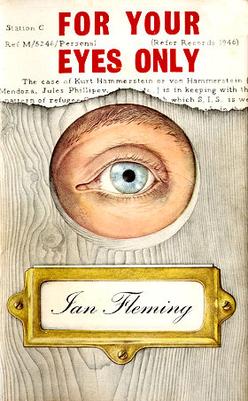
A Study of Adaptation - For Your Eyes Only

Fleming's eighth entry in the James Bond series is an unusual case. Published in 1960, it's a collection of short stories rather than a novel. As such, I'll be looking at the five stories in turn. You might want to put the kettle on and grab a comfortable seat.

The first story is From a View to a Kill, in which Bond is investigating the robbery and murder of a dispatch rider who was travelling from the Supreme Headquarters of Allied Powers in Europe (SHAPE) in Versailles to the MI6 Station F in Saint-Germain.

A View to a Kill is the title of the fourteenth entry in the film franchise, released in 1985. However, it does not utilise anything from the short story other than part of the title and a Paris setting. That said, Bond does fantasise about a woman named Solange, who later appeared in the film version of Casino Royale.

Next we have the so-called feature presentation, For Your Eyes Only. In this one, Bond is sent to Vermont to assassinate Herr von Hammerstein, a former Gestapo officer who escaped to Cuba and served as a counterintelligence officer in Fulgencio Batista's regime (Batista had been overthrown at the beginning of 1959, so presumably this story had been written before then). Von Hammerstein's accomplice, Major Gonzales, had attempted to buy a Jamaican estate from Colonel Timothy Havelock and murdered him and his wife when he refused. As the Havelocks are old friends of M, the head of MI6 offers an assassination mission to Bond. However, he soon encounters the Havelocks' daughter Judy on her own revenge mission.

For Your Eyes only would become the twelfth Bond film, released in 1981, and does utilise elements from the short story at the beginning. In the film, Sir Timothy Havelock is a marine archaeologist hired by the Secret Service to search for a missing spy ship in the Ionian Sea. He and his Greek wife are killed by Hector Gonzales, a Cuban hitman. Bond is sent to question Gonzales in Madrid, but is captured. He escapes when Havelock's daughter Melina shoots Gonzales with a crossbow as he dives into a pool (she kills von Hammerstein in the short story this way, albeit with a bow and arrow). Von Hammerstein has been removed from the film, but Bond later identifies Emile Leopold Locque as the man who paid Gonzales and searches for him in Cortina. As this was adapted from a short story, they had to make some of these changes to better suit a larger story. This includes incorporating another short story from this collection.

The third story, Quantum of Solace, is supposed to be a pastiche of the works of W. Somerset Maugham. Bond is attending a function at Government House in Nassau, after completing a mission in the Bahamas. He is then related a story by the governor about the gradually declining marriage of a civil servant named Phillip Masters and a flight attendant named Rhoda Llewellyn. Quantum of Solace was the 22nd film, released in 2009, but like A View to a Kill, it doesn't use anything from the source material other than the title.

Risico follows Bond as he travels to Italy to take down a drug smuggling ring. He meets a CIA informant named Kristatos, who points him in the direction of a smuggler named Enrico Colombo. Bond is eventually captured by Colombo, who is in a long-standing feud with Kristatos, learning that Kristatos is behind the scheme and was using him to silence Colombo.

The events of Risico were also utilised in the film adaptation For Your Eyes Only, but the setting is changed to Greece. This includes Colombo's raid on Kristatos' warehouse in Albania, which gets blown up. In the short story, Kristatos tries to escape afterwards, but is shot by Bond while driving away. In the film, this is changed to Locque, so Kristatos can be dealt with in the third act. The film version of For Your Eyes Only also borrows from Live and Let Die, using a scene in which Bond is dragged across a reef to serve as shark bait.

Finally, we have The Hildebrand Rarity. Bond is having some down-time in the Seychelles after a mission, when his local contact, Fidele Barbey, invites him on a local expedition with Milton Krest, an uncouth American millionaire. Krest takes them aboard his luxury yacht, the Wavekrest, on the pretence of searching for an exotic fish for the Smithsonian, the eponymous Hildebrand Rarity.

Like Risico, The Hildebrand Rarity did not get its own adaptation, but some elements were utilised in Licence to Kill, released in 1989. The character of Milton Krest appears as a high-raking member of the drug cartel headed by Franz Sanchez, and his marine research vessel, the Wavekrest, serves as a front for his operations. The film also has Sanchez beating his mistress with a stingray tail, similar to how Krest treats his wife in the short story. Krest's demise is different in the film; he's framed for embezzlement by Bond, and is killed using a decompression chamber which causes his head to explode. In the book, he's choked to death on the rare fish he'd sought, and Bond dumps him overboard to make it look like an accident. Again, because this was a short story, I guess there was a need to expand things. Especially because the film wasn't a direct adaptation.

Phew, that took a while.

Monday, 24 June 2019

"Once Upon a Time" with Kate Forsyth

Yes, I did mention this tweet
I'm taking a short interlude from my regular project on this blog to discuss a talk I attended today by author Kate Forsyth, who writes re-tellings and adaptations of fairy tales for adult audiences. Her most notable work is Bitter Greens, an adaptation of Rapunzel with three separate narratives:

  • A historical bio-fiction about Charlotte-Rose de la Force, a story-teller and courtier who wrote Persinette upon which Rapunzel is partly based.
  • A "pure adaptation" of Rapunzel, following Margherita as she is imprisoned in a tower by a witch
  • An expansion of the story following the witch, Selena Leonelli, as she aims to preserve her life by any means necessary
I first read Bitter Greens as part of my university course. As previously mentioned on this blog, I did an elective module in English Literature on Adaptation, and the second term looked at adaptations of fairy tales, with Bitter Greens being one of the set texts. 

In her talk, Forsyth discussed how the protagonists of fairy tales are a metaphor for the human spirit, with the rest of the content representing the trials and tribulations we face every day. With this in mind, we see how these fairy tales endure through re-tellings. Anybody can project themselves onto the protagonist of a fairy tale, and use the obstacles faced to represent their own struggles. The discussion was absolutely fascinating, and I suppose I unconsciously applied this myself when I first read the book.

As the post image shows, I once tweeted about the first part of the story, in which Charlotte-Rose de la Force is sent to a convent after a scandal, which includes the nuns taking away her writing implements. Now, before I went to university, I was working as an accountant. However, I'd been struggling to fit my writing around a five-day working week. I became depressed and resentful, feeling like my job was getting in the way of what I wanted to do. I suppose this is why that particular chapter resonated with me. Anyway, I tweeted about it and actually got a response from Forsyth. I mentioned it to my tutor and was asked to send over a screenshot of the tweet and her response.

Even now, that story still has an influence. For one of my later assignments, I had to write a historical flash fiction. So, I wrote about Julie d'Aubigny an opera singer who lived around the same time as Charlotte-Rose de la Force. Her most notorious story involved starting a fire in a convent to rescue a girl with whom she was romantically involved. Having read through Bitter Greens and the harsh life experienced there by Charlotte de la Force, Julie's wild adventure actually came across as heroic to me.

I do recommend Bitter Greens, and I hope to check out more of Kate Forsyth's work in the near-future. And one final thing which resonated with me was how she discussed wanting to write. I could really relate to this as well.

Sunday, 23 June 2019

A Study of Adaptation - Goldfinger

There's a bit of a content warning for this one, and I'll refer you to the appropriated Looney Tunes disclaimer in my post on Live and Let Die. Anyway, Goldfinger is the seventh novel in series, published in 1959, and the third entry in the film series, released in 1964. Compared to the film, there are many elements in the novel which are utterly ridiculous.

The novel is split into three parts, based on Bond's meetings with the eponymous villain: "Happenstance", "Coincidence", and "Enemy Action".

In "Happenstance", Bond is on a layover in Miami when he meets Junius Du Pont, who had also taken part in the baccarat tournament in Casino Royale. Du Pont has been playing canasta with Auric Goldfinger, and asks Bond to investigate whether or not he has been cheating. Bond discovers Goldfinger's methods and seduces his accomplice, Jill Masterson.

In "Coincidence", Bond is assigned a mission on behalf of The Bank of England to determine if and how Goldfinger is illegally smuggling gold bullion. He plays golf with the magnate in Sandwich, and then follows him to Switzerland. He discovers Goldfinger's method of transporting gold, but is captured alongside Tilly Masterson when she attempts to avenge the murder of her sister.

In "Enemy Action", Bond narrowly avoids being cut in half with a circular saw by offering his and Tilly's services to Goldfinger. They're employed as secretaries and taken to New York for a meeting with several mob bosses: Mr Solo from the Sicilian Mafia; Jack Strap, the new leader of the Nevada-based Spangled Mob (from Diamonds Are Forever); and Pussy Galore, leader of an all-female gang of cat burglars known as The Cement Mixers. Goldfinger's plan is to rob the US bullion reserve at Fort Knox in Kentucky, and plans to blow open the vault using a nuclear bomb given to him by the Russians.

We'll look at a few minor changes. In the film, Bond is on official business from the start, getting a signal from London while in Miami to observe Goldfinger. Jill Masterson is killed in Bond's hotel room by being painted gold, dying from "skin suffocation". The novel uses this (inaccurate) cause of death as well, but it's only mentioned by Tilly. Meanwhile, Pussy Galore is now Goldfinger's personal pilot and has trained a flying circus of all-female pilots.

A lot of major changes were made in order to make them more plausible. For example, Bond avoids being cut in half by a laser by claiming his people know about Goldfinger's "Operation Grand Slam", prompting Goldfinger to spare him in order to ascertain how much he knows. This sounds a bit more plausible than offering to be a secretary.

In a similar regard, Goldfinger doesn't wish to rob Fort Knox in the film. Instead, his scheme is to detonate a "dirty bomb" in the vault given to him by the Chinese government (rather than the Russians). This atomic device would irradiate the US gold reserve, rendering it worthless and causing economic chaos in the West while simultaneously increasing the value of Goldfinger's own bullion. This makes more sense than trying to rob it, although that's discussed in the film. Plus it provides a climax which can take place inside the vault.

One of the other reasons for major changes is due to sanitisation. The filmmakers had to tone down a lot of very blatant racism, sexism, and homophobia in the books. For example, Goldfinger's Korean manservant Oddjob is depicted in the book as liking to eat cats, while Bond often refers to him as an "ape". Those aspects were removed in the film. Something tells me that Ian Fleming wasn't too fond of Korea. Yes there had been a war there six years earlier, but surely Fleming had left military intelligence at that point.

Meanwhile, the book establishes that both Tilly Masterson and Pussy Galore are lesbian. Tilly even believes that Pussy Galore will protect her during Operation Grand Slam, but ends up getting killed by Oddjob while trying to escape. Pussy Galore on the other hand, ends up with Bond afterwards. I've heard that there were strict laws regarding the depictions of homosexuality in pulp novels (mainly for the printing of smut, apparently), but I don't know if they were still in effect in 1959.

Anyway, Tilly is killed off earlier in the film, when Bond is captured in Switzerland. And Pussy Galore is depicted as just being aloof. Hollywood was still under the rules of The Hayes Code at this point, and homosexuality was one of the things it didn't allow. While these films were made in Britain, they were still being distributed by an American studio (and catering specifically to the American market), so they probably would have been subject to the code. I've heard the filmmakers actually had to fight to avoid changing Pussy Galore's name to Kitty Galore.

Overall, there was a lot of changes which had to be made for this one. I'll leave robbing the US federal reserve to Simon Gruber in Die Hard: With a Vengeance.

Monday, 17 June 2019

A Study of Adaptation - Dr No

After the cliffhanger ending of From Russia With Love, there was an audience demand to read more Bond, so Fleming didn't end the franchise. Dr No is the sixth novel, published in 1958, and the first film, released in 1962.

After recovering from his run-in with Rosa Klebb, Bond is sent on a rest cure to Jamaica. The MI6 station chief, Commander Strangways (whom he worked with in Live and Let Die), has disappeared with his secretary, and his house has burned down with all his records. Bond is sent to investigate the disappearance, learning that Strangways was looking into the deaths of two representatives of The National Audubon Society on the island of Crab Key. The island is home to a colony of roseate spoonbills, which are protected by the Society, and a guano mine owned and operated by the reclusive Dr Julius No. Bond travels to Crab Key with his old friend Quarrel, and later meets a shell diver named Honeychile Rider. They soon fall afoul of Dr No's strict security forces (including the fabled "dragon" of Crab Key).

In the film, Bond is still investigating the disappearance. This time, Felix Leiter of the CIA is also present; he and Strangways had been investigating the toppling of American missile tests and traced the mysterious signals to the Caribbean. This is revealed to be Dr No's secret operation in the novel, but never really comes to play. The film removes all references to the National Audubon Society to accommodate this. Like in most subsequent adaptations, Dr No is working for SPECTRE rather than the Russians.

The novel seems a lot more "cinematic" than the previous novels in the series, more akin to a classic pulp adventure, featuring an exotic locale and a "Fu Manchu"-style villain with an elaborate underground base. I guess that's a reason to make this the first film in the series. Of course, that still means they have to make other changes:

  • In the film, Quarrel is initially distrustful of Bond, but makes friends when he realises that he and Felix are working the same case. This would have been necessary, as it was the first film. Quarrel had appeared previously in Live and Let Die, so already knew Bond. As such, when Live and Let Die was adapted to film, Bond is aided on San Monique by Quarrel Jr.
  • Dr No's front operation is a bauxite mine rather than guano in the film. I suppose this is because the guanay cormorants which produce the guano aren't native to the Caribbean, preferring a Pacific coastal environment.
  • One tense scene in the novel features an attempt on Bond's life by putting a centipede in his hotel room. In the film, this is replaced by a tarantula. Most likely because Sean Connery is afraid of spiders.
  • Honey Ryder's introduction. We all know the iconic scene in the film where Ursula Andress gets out of the sea in her white bikini. In the novel, she was wearing a knife belt, and nothing else. Fair enough, they wouldn't want to show that level of nudity on a widely-released film. She's also described as having a broken nose in the novel. I guess Hollywood wasn't ready to put that onto film either.
  • On the subject of Honey, she receives far less characterisation in the film. The novel establishes her as somewhat naive and childlike, which actually makes Bond reluctant to seduce her. The film tones this down, and doesn't let her demonstrate her knowledge of the fauna in the same way (I cited Honey as one of the negative aspects of the film for this).
  • One example of a scene which didn't make it into the film was Dr No's planned fate for Honey. In the novel, she's pegged out to be eaten by crabs. However, she knew they weren't dangerous and let them pass over her before escaping. They did try and film this, but couldn't get the crabs to behave and scrapped it. Instead, they just leave her in a flooding room to be rescued by Bond.
To be fair, a lot of the changes had to be made in the film due to budgetary constraints. After all, it was the first film in the series, based on a book series which had a relatively niche audience. I mean, I saw the films before I read the books, and have the feeling that also applied to a lot of people in the sixties.

The End of the Third Year

  The closest thing to posing by the campus sign with a printed dissertation. Well, here I am at the end of the line. I got my results yeste...